
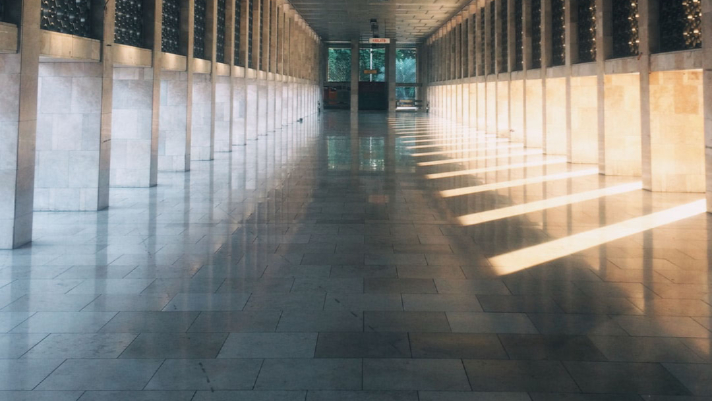
When thinking of industrial flooring, there are many different types of materials to choose from. Durability and cost-effectiveness are important factors to consider, but style and comfort can come into play, as well as longevity. Here are the three best industrial flooring materials and how they can work for you.
Polished Concrete
An easy option is to keep the already set concrete as your industrial flooring since it is incredibly durable. However, the issue with using unfinished concrete as an industrial flooring base is mainly how porous it is. When used in the food and beverage industry, water or food spills, leaks, or chemical spills can seep into the concrete and may cause bacteria to grow. This can prove extremely problematic for an industry so reliant on upkeeping certain health standards.
Polished concrete offers the same durability and performance that unfinished concrete does, but it is moisture and bacteria resistant. The process of polishing the unfinished material leaves the concrete shiny, almost like an epoxy. The shiny, marble-like appearance left after the concrete is polished is a great alternative to high end flooring such as granite or even tile. However, polished concrete will need touch-ups in high-traffic areas as time passes.
Epoxy
As one of the most popular industrial flooring types, epoxied floors are long-lasting and low maintenance. Among the best looking of all industrial flooring options, epoxy is completely customizable and can come in a variety of colors. Due to the degree of skill needed to install correctly, the epoxy process can get expensive and take a great deal of time. However, the time and money spent are well worth it as epoxy flooring generally only needs a quick mop to clean.
Epoxied industrial flooring is not porous like concrete floors. Therefore, it is protected from bacteria growth and stains or spills, making it perfect for use in the dairy industry or food industry. However, it is recommended to use anti-slip additives during the installation process to keep the floors from getting slick when wet. This also adds to the cost, but it will extend the life of the floors.
Rubber Tile
Depending on where the industrial flooring is located, rubber tile can be a great option as well. This material offers comfort and safety to those who walk on it for long periods of time. Dings, scratches, and stains won’t show on this type of industrial flooring either due to the general look of the material. It is a more expensive option but it is incredibly durable. The rubber industrial flooring tile is perfect for a gymnasium or outdoor facility as it naturally becomes more slip-resistant when wet.
No matter what your needs are, there is an industrial flooring type that is right for you. Contact The Project Group today to learn more about your flooring options.
 Pamela began her professional career in the broadcast industry while attending Tarleton State University. After graduating with a B.S. in Speech Communication in 1997, she worked at several radio stations in management roles focusing on continuity, music and production as well as serving as an on-air talent continuously for more than ten years. In 2010, Pamela accepted a position as the Assistant Marketing and Development Director for the Eisemann Center in Richardson, TX. Helping to promote, market and develop the City of Richardson’s performing arts center, she succeeded in implementing and managing all social media marketing as well as creating and directing a first-ever student art exhibit, further strengthening her marketing and organizational talents.
 Jason Krueger is the Director of Ranch and Real Estate Development for The Project Group Consulting, LLC. Jason has been managing and developing ranches for greater than 14 years, and has extensive sales management experience in the construction industry dating back to the late 90s. He is also a Wildlife Biologist/Ecologist with a B.S. in Wildlife Ecology from Texas A&M University in College Station.
 Bryant began his career at Crepaco warehouse in parts distribution and pump assembly. Then he progressed to field installation for process and ammonia systems where he oversaw welding and fitting both sanitary tubing and ammonia piping systems.He then moved to San Antonio, spent a year as a contract fabricator with H-E-B Foods working for Sanitary Welding Services. At the end of his contract he returned to the DFW area with Alloy Equipment doing installation, crew management, and scheduling. There he remained through the buyout by Statco Fabrication and Engineering, which resulted in his 25 combined years with them moving into engineering and sales departments.
 With more than 25 years in the food and beverage industry and extensive experience as a project manager, Tony has planned and led multi-million dollar projects relating to system upgrades, equipment installation, water quality, validations and process improvements. Some of his areas of expertise include project planning, quality assurance, process analysis, manufacturing systems, process design and problem resolution.
 Tim is an electrical and control systems engineer with more than ten years of experience in a wide variety of industries. Project experience includes working with clients in the water/wastewater fields, pharmaceutical, cosmetics and food and beverage industries. Prior to his engineering work, Tim was a licensed water treatment plant operator in Texas. Tim’s strengths are process engineering, control system design, conveyor system design, and project management. He received his B. S. in Electrical Engineering from the University of Texas at Arlington. In his spare time, Tim enjoys working on cars, golfing, and billiards.
 Michael has thirty-five years of diversified experience in project management and engineering, equipment and systems design, and manufacturing and production. Michael holds a Bachelor of Science degree in Mechanical Engineering from Texas A&M University.