
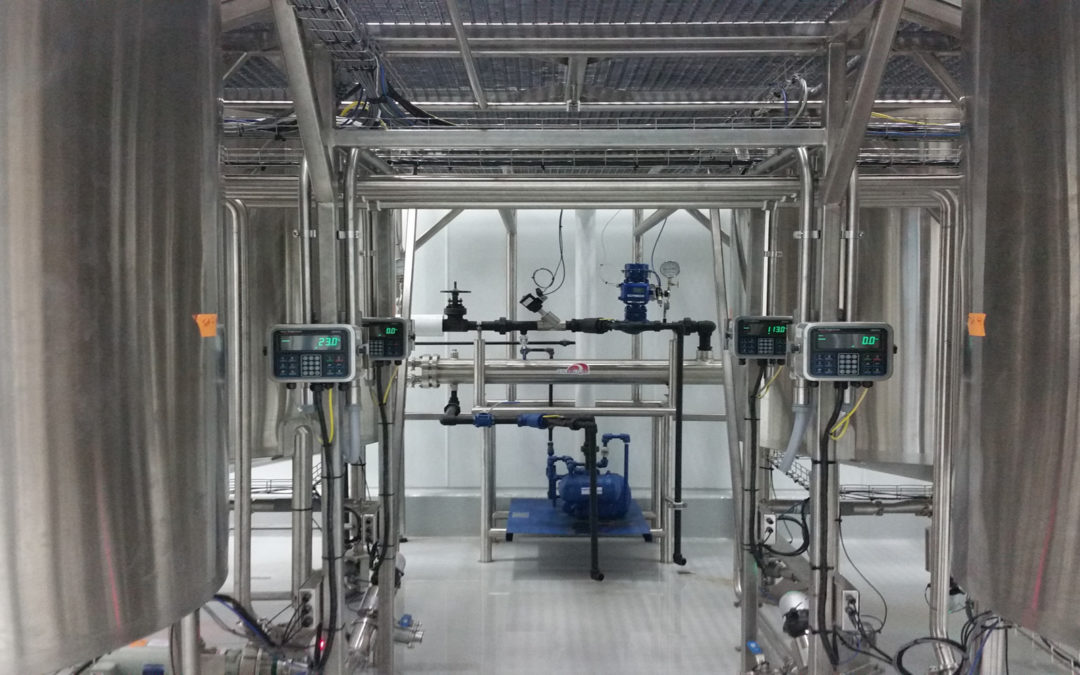
Deciding on an industrial flooring solution for a workplace that operates in the food processing industry is a much more detailed process than you may think. The flooring will need to hold up to certain health codes and wear and tear that it wouldn’t be subjected to in other industries. Here are some of the most important traits to consider when picking an industrial flooring solution.
Seamless and Non-Porous
The main concern with industrial flooring in the food processing industry is keeping bacteria and mold out of the working area. Some flooring solutions, like unpolished concrete, are porous and allow for materials to settle into them. It is difficult to clean this kind of flooring, thus the materials are left to mold and create hazards for the food being processed. Other types of flooring that are installed with seams also allow for materials to settle and bacteria to grow. This is why it’s important for facilities that operate as part of the food processing industry to consider an industrial flooring solution that is both seamless and non-porous, such as polished concrete or epoxy.
Easy to Clean
Another concern for flooring in the food processing industry is the ease at which it can be cleaned and disinfected. With many different foods and products being used in the work area, there are likely to be splashes and spills that leave materials on the floor. Not only is it important to clean these spills for health reasons, but the floor also needs to be easily cleanable for safety reasons. Any stickiness or slick areas could cause falls for employees. Flooring like polished concrete and epoxy are smart choices for the food processing industry because they are easy to spray off and clean, more so than other flooring choices.
Durable
Flooring at a food processing plant is likely to see a lot of traffic, whether by foot or by machinery and materials being moved around. When considering industrial flooring solutions in the food processing industry, it is important to look for flooring that will hold up to years and years of traffic. Polished concrete flooring has quickly become a popular alternative to tile and linoleum for many commercial facilities due to its excellent durability and performance. Epoxy is another long-lasting and low maintenance option when paired with anti-slip additives.
When choosing an industrial flooring solution for the food processing industry, these are the top factors to consider. Contact The Project Group today to discuss which flooring solution is best for your workplace.
 Pamela began her professional career in the broadcast industry while attending Tarleton State University. After graduating with a B.S. in Speech Communication in 1997, she worked at several radio stations in management roles focusing on continuity, music and production as well as serving as an on-air talent continuously for more than ten years. In 2010, Pamela accepted a position as the Assistant Marketing and Development Director for the Eisemann Center in Richardson, TX. Helping to promote, market and develop the City of Richardson’s performing arts center, she succeeded in implementing and managing all social media marketing as well as creating and directing a first-ever student art exhibit, further strengthening her marketing and organizational talents.
 Jason Krueger is the Director of Ranch and Real Estate Development for The Project Group Consulting, LLC. Jason has been managing and developing ranches for greater than 14 years, and has extensive sales management experience in the construction industry dating back to the late 90s. He is also a Wildlife Biologist/Ecologist with a B.S. in Wildlife Ecology from Texas A&M University in College Station.
 Bryant began his career at Crepaco warehouse in parts distribution and pump assembly. Then he progressed to field installation for process and ammonia systems where he oversaw welding and fitting both sanitary tubing and ammonia piping systems.He then moved to San Antonio, spent a year as a contract fabricator with H-E-B Foods working for Sanitary Welding Services. At the end of his contract he returned to the DFW area with Alloy Equipment doing installation, crew management, and scheduling. There he remained through the buyout by Statco Fabrication and Engineering, which resulted in his 25 combined years with them moving into engineering and sales departments.
 With more than 25 years in the food and beverage industry and extensive experience as a project manager, Tony has planned and led multi-million dollar projects relating to system upgrades, equipment installation, water quality, validations and process improvements. Some of his areas of expertise include project planning, quality assurance, process analysis, manufacturing systems, process design and problem resolution.
 Tim is an electrical and control systems engineer with more than ten years of experience in a wide variety of industries. Project experience includes working with clients in the water/wastewater fields, pharmaceutical, cosmetics and food and beverage industries. Prior to his engineering work, Tim was a licensed water treatment plant operator in Texas. Tim’s strengths are process engineering, control system design, conveyor system design, and project management. He received his B. S. in Electrical Engineering from the University of Texas at Arlington. In his spare time, Tim enjoys working on cars, golfing, and billiards.
 Michael has thirty-five years of diversified experience in project management and engineering, equipment and systems design, and manufacturing and production. Michael holds a Bachelor of Science degree in Mechanical Engineering from Texas A&M University.